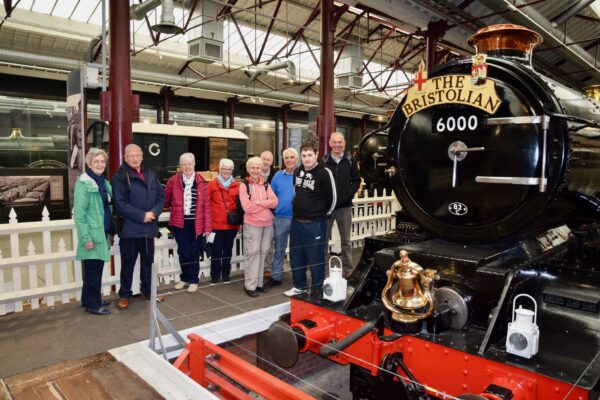
Tuesday, 21st April saw 23 Friends heading towards Swindon for what proved to be an excellent and varied day out.
Our first venue was STEAM – the Museum of the Great Western Railway – sited on the old railway works responsible for the growth of Swindon. After a short welcome by Museum staff, we were free to experience the magnificent exhibitions.
Moving through re-constructed offices and supply stores, these gave an insight into the large number of jobs and processes involved. In its heyday the works, covering 62 acres, employed 14,000 people; 250 coaches and 104 locomotives a year were designed, built and fitted as well as the repair work. Embedded in the exhibits were touch button explanations of the life and work of the employees, many with superb archive film and interviews with former employees.
Health and Safety was very different in those days, but the workforce seemed well looked after and loved their jobs. Many of the exhibits of locomotives, coaches, the signal box, were the originals and used authentic materials. This gave a sense of scale to the works before the 1950s.
In the afternoon, we visited Lydiard Park Museum and Gardens, where we enjoyed lunch. The House was opened specially for our visit. In its present form, the House dates from 1743, but there have been several re-modellings. It was mentioned in the Domesday Book and there are family portraits dating from Tudor Times. In 1943, it was bought by Swindon Corporation, now Swindon Borough Council who own and run it, having been open to the public since 1955.
The rooms open to us were impressive and the touch button explanations intriguing. For instance, most of the portraits in one room have grey frames, replacing gilded ones, which were sold to help pay for ‘family scandalous lifestyles’. They were replaced by white painted frames which, with age, are now grey. There was a framed Royal Pardon from Charles II whereby one of the ancestors was pardoned for killing another noble. The miscreant’s lands were returned to the family, but all at a huge cost.
The extensive Parkland looked beautiful in the sunshine, featuring two lakes and a fountain as well as a walled garden. A smaller lake had been an essential source of food, mainly fish, and in historic times Queen Elizabeth1 dined on fish from it. The walks were lovely with splendid views of the House and St. Mary’s Church. Unfortunately, the Church was locked so we could only look at the exterior features and read the information board.
At both venues the staff were friendly, informative and enhanced our enjoyment. We had a wonderful day with everyone enjoying themselves.
Galleries